Borderlands Become New Opium Frontier
Satellite data reveals 9,000 hectares of new poppy fields in Pakistan and Iran as Afghan farmers move across the border.
By Sergio Nunez ·
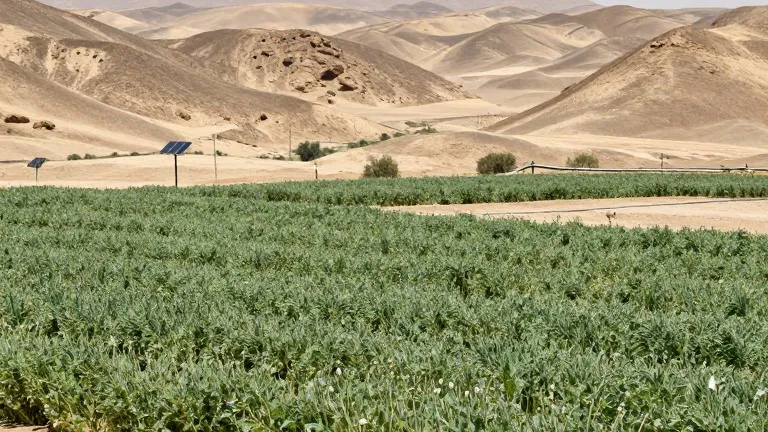
Satellite imagery from the British firm Alcis identified more than 9,000 hectares of poppy cultivation in Pakistan's Balochistan province. The discovery marks a sharp shift in global opium production away from Afghanistan and into its neighboring borderlands. David Mansfield, a UK-based expert on illicit drugs, stated that these remote areas have become a global center for opium production following the Taliban's 2022 ban on narcotics.
The expansion is driven by Afghan farmers from Kandahar and Helmand provinces who are leasing land across the border. These growers bring capital and technical expertise to Pakistan and Iran. In Balochistan, they invest millions of Pakistani rupees in solar-powered wells and share profits with local landowners. Mansfield noted that many farmers doubled their cultivated land in 2026, signaling that production levels will likely rise further in 2027.
Pakistan's Interior Ministry and provincial government have not responded to requests for comment. Islamabad has denied the scale of the crop and claims that discovered poppies are destroyed. The United Nations Office on Drugs and Crime estimates that opium production in Pakistan remains marginal. However, the agency acknowledged that recent data suggests a degree of spillover effects from the Afghan ban. In Iran, Sistan-Baluchistan remains the primary producing region, with satellite images showing extensive fields that utilize costly drip irrigation systems.
Local officials and residents describe a complex dynamic of enforcement and evasion. Monawar Hussain, the chief administrative officer of Killa Abdullah district, rejected claims that cultivation is rampant. He said the crop declined after an eradication campaign last year. However, Alcis imagery from 2026 shows no clear evidence of that destruction. Abdul Qahar Wadan, a former National Assembly member, alleged that senior military officials and power brokers back the growers and take commissions. A farmer in Killa Abdullah, speaking anonymously, claimed that growers sometimes plant poppies on barren land so officials can destroy them for public display when media pressure mounts.
Economic hardship is a primary driver for local farmers. Lala Jan Kakar, a resident of Killa Abdullah, said that drought and flash floods have devastated traditional fruit farming. He stated that the demand and income from poppies now far exceed those from fruits. In Afghanistan, cultivation is also rebounding inside the country despite the ban. Production is concentrated in the northeast and southwest, with southwestern cultivation almost doubling between 2025 and 2026. Mansfield warned that a recent Taliban directive barring home searches without a court order could be read as a signal that authorities tolerate cultivation beyond walled compounds.
The shift is changing the nature of farming in the region. Mansfield described a move from mixed farming to large-scale poppy monoculture in Pakistan and Iran. In Afghanistan, farmers in Badakhshan and Helmand have protested and defied the ban due to drought and debt. Experts expect that the instability in the tri-border area will continue to support widespread cultivation. Armed groups in the region are competing for tax revenues from the drugs trade, people smuggling, and the exchange of fuel and minerals. This economic activity is stoking violence as the Taliban faces a deepening economic crisis.