US Moves Third Carrier as Iran Prepares for Post-Vote Conflict
Military buildup coincides with a surge in early midterm voting and ongoing debates over grocery inflation.
By Francesca Youssef ·
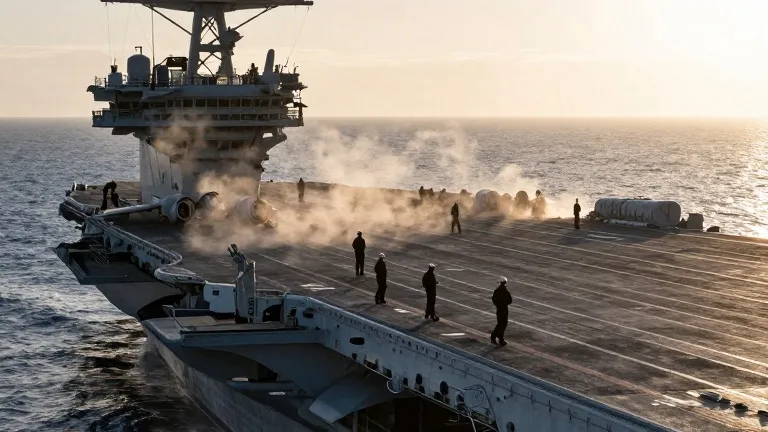
The United States is dispatching its third aircraft carrier to the Middle East region. This move occurs while roughly 21 million Americans have already cast ballots ahead of the November 3 midterms. A source familiar with the war planning between Washington and Jerusalem stated that both nations are preparing for a potential strike on Iran following the election.
Greg Myre, an NPR correspondent, noted that President Trump intends to evaluate military options after voters finish. He aims to prevent a spike in oil prices from influencing the outcome. Defense Secretary Pete Hegseth recently visited Israel to meet with Prime Minister Benjamin Netanyahu. This trip underscored the close coordination between the two leaders as tensions rise.
Iranian Foreign Minister Abbas Araghchi declared that Tehran is ready for both diplomatic talks and war. Myre reported that while the US and Israel possess the capacity to inflict heavy damage, Iran shows little willingness to offer major concessions. Instead, the Iranian government is demanding formal control over the Strait of Hormuz and the complete withdrawal of US troops from the area.
In the US, early voting figures have climbed rapidly. The University of Florida's Election Lab reported that the total number of ballots cast increased by about 2 million in a single day. Saige Miller, another NPR correspondent, observed that participation in key swing states is currently higher than during the previous midterm cycle. However, she cautioned that early numbers do not always predict final results. Democrats tend to vote earlier, while Republicans often turn out on Election Day itself.
A federal judge in California has limited the Department of Homeland Security's pre-election field operations. The agency claims these efforts identify noncitizens who allegedly voted illegally in nine states. Meanwhile, a federal magistrate ordered President Trump to sit for a deposition in his $10 billion defamation lawsuit against the BBC. The judge ruled that Trump must comply with court rules or face financial sanctions.
The legal dispute stems from a Panorama broadcast aired in late October 2024. That program allegedly edited a speech Trump gave on January 6 to suggest he incited a violent attack on the US Capitol. Trump has labeled the broadcast false and misleading under Florida law. The BBC apologized for the splicing and now seeks to understand the President's state of mind during that address. BBC attorneys note that over 200 defendants in related cases cited the speech as a motivation.
Domestic economic issues continue to shape the political landscape. Although President Trump promised lower prices, overall grocery costs have risen due to labor expenses, tariffs, and energy prices linked to the Iran conflict. The Bureau of Labor Statistics shows ground beef reached $6.79 per pound last month, an 85% increase over the past decade. Eggs dropped to $2.27 per dozen after peaking at $6.23 in March 2025. Butter prices fell 17.3% year-over-year to $3.96 due to oversupply, while coffee remains 44% more expensive than it was two years ago.