France Allocates 70,000 Police for New Saturday Marches
Interior Minister Laurent Nuñez announced a nationwide deployment backed by armored vehicles, as cultural venues close and shopkeepers board up stores ahead of the weekend.
By Francesca Youssef ·
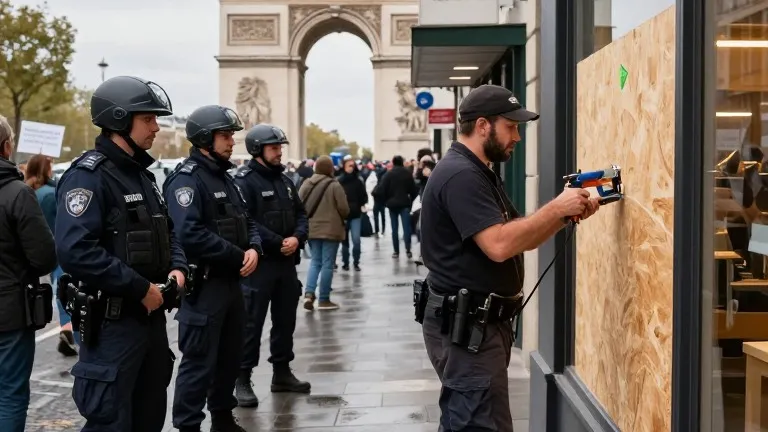
Interior Minister Laurent Nuñez confirmed on Friday that up to 70,000 police officers will be deployed across France for Saturday’s demonstrations. The mobilization includes helicopters, armored vehicles, and water cannons to manage a second major wave of unrest. This follows a previous weekend in which more than 500,000 protesters took to the streets, resulting in looted shops and burned vehicles.
The government adjusted the primary march route in Paris to mitigate potential disruptions. The demonstration is now confined to the city’s southeastern edge, running between Porte d'Italie and Porte de Vincennes. This change diverts the crowd from the originally planned path between Bastille and Nation. Authorities posted dozens of gendarmes beneath the Arc de Triomphe and along adjacent avenues to secure central districts.
Protesters are demanding specific economic and educational reforms. Student groups released a 10-point plan that calls for 250,000 additional places in higher education and the end of the Parcoursup admissions selection system. They also seek an increase in monthly student grants to 200 euros, roughly 313 Canadian dollars, alongside a rent freeze in public housing. Labor unions have joined the march to demand higher wages and pension protections to offset rising living costs.
Businesses in affected areas have taken preemptive measures to protect assets. Approximately 3,000 shops across France were damaged or looted during the previous weekend’s clashes. In Paris, major cultural venues including the Louvre, Musée d'Orsay, and the Grand Palais are closed for Saturday. The Grand Palais is currently hosting a major Cézanne exhibition, which is inaccessible to the public during the protest period.
Art Basel, a major art fair, opened to the public for a single day on Friday before organizers canceled its weekend program. Shop owners are physically securing their premises. Akram Ahmed, a 34-year-old contractor, boarded up an optician’s shop near Saint-Lazare station on Friday. He stated that the owner contacted him the previous night, explaining that the work was necessary to save the business.
Local authorities in several cities banned marches, including in Lyon, Nice, and Montpellier, while allowing rallies in Paris and Marseille. Police used tear gas in Lyon on Saturday morning. Trade unions have challenged the bans, citing constitutional protections for freedom of expression. Outside the capital, two suspects in the fire that damaged the 19th-century city hall in Limoges are under formal investigation. The probe includes attempted murder of a public official.
President Emmanuel Macron, whose popularity is at a personal low, has justified the security measures as necessary to protect city centers and public buildings. In Orléans, thousands gathered for an anti-far-right protest coinciding with a congress of Marine Le Pen’s party. Victoria Ambrosini, an art teacher at Saint-Denis University, noted that money is now concentrated in the hands of very few people. She added that the current economic structure is no longer sustainable.
The next presidential election is scheduled for next spring. The current unrest highlights tensions over school funding and household costs. Police prefect Patrice Faure advised shopkeepers to hire private security guards, though he later clarified that protecting businesses remains a government responsibility. The mobilization marks the largest police deployment for a protest weekend in recent years.
More Business · World news · Rip-Off Report · Report a business · Got a Story?