Ukraine Restores 400km/h Drone Speeds After Starlink Limitations Lifted
Defence Minister Yevhenii Khmara confirmed that satellite connectivity has returned to full capacity, ending a multi-day disruption that affected military operations.
By Ananya Wright ·
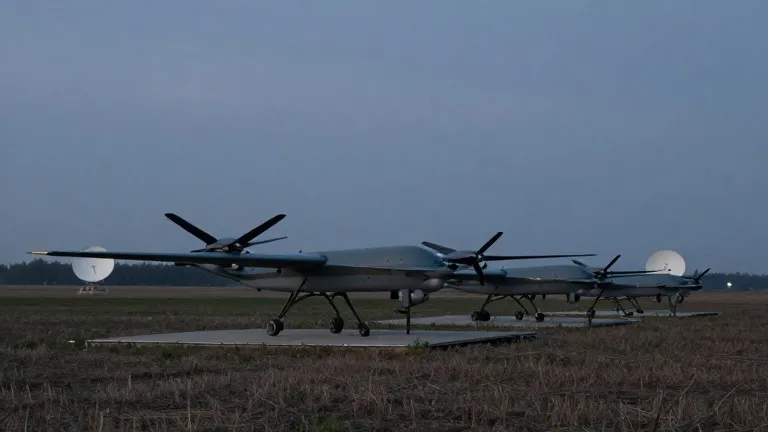
Ukraine has confirmed that its military satellite connections are fully operational again after several days of restricted speeds.
Defence Minister Yevhenii Khmara announced the restoration of service in a statement on Saturday. He noted that drones can once again travel at speeds exceeding 400km/h without losing their link to the network. Khmara emphasized that this capability is vital for front-line soldiers, drone operations, and logistics.
The disruption forced Ukrainian forces to manage with reduced connectivity. Officials previously reported that drones lost their Starlink signal when moving at or above 161km/h. This limitation stemmed from instructions reportedly given by US President Donald Trump to Elon Musk, the owner of Starlink. While Trump initially denied issuing such orders, he later stated that Musk had resolved the issue.
The conflict highlights Ukraine's reliance on both the civilian Starlink service and the military-grade Starshield system. The nation uses a network of 10,000 low Earth orbit satellites to pilot drones and coordinate attacks, particularly in remote areas of the battlefield. Musk has indicated that the US military controls Starshield and suggested the Pentagon may have been involved in the recent connectivity problems.
This technical dispute occurred alongside a wider diplomatic tension between Washington and Kyiv. The friction centers on Ukrainian strikes against Russian oil infrastructure, which have impacted global fuel prices. Trump has argued that these attacks drive prices up, while Kyiv maintains they are essential to reducing Moscow's war revenue. With US midterm elections approaching next month, Trump has also waived some sanctions on Russia and agreed to import Russian diesel, a move criticized by Ukraine and its European allies.
On the ground, fighting continued as satellite issues were resolved. Russia's defence ministry reported on Saturday that its air defenses shot down 616 Ukrainian fixed-wing drones. These strikes hit several regions, including the Russian-annexed Crimea. Sergey Aksyonov, the Moscow-backed governor of Crimea, said the attacks caused power cuts, leading to local restrictions on electricity and water.
Ukrainian authorities stated they targeted a missile component manufacturer, a chemical plant, and an aircraft at a military airfield within Russia in the past 24 hours. They also recorded 88 Russian air strikes on Friday, during which Moscow deployed 309 glide bombs and 10,270 kamikaze drones.