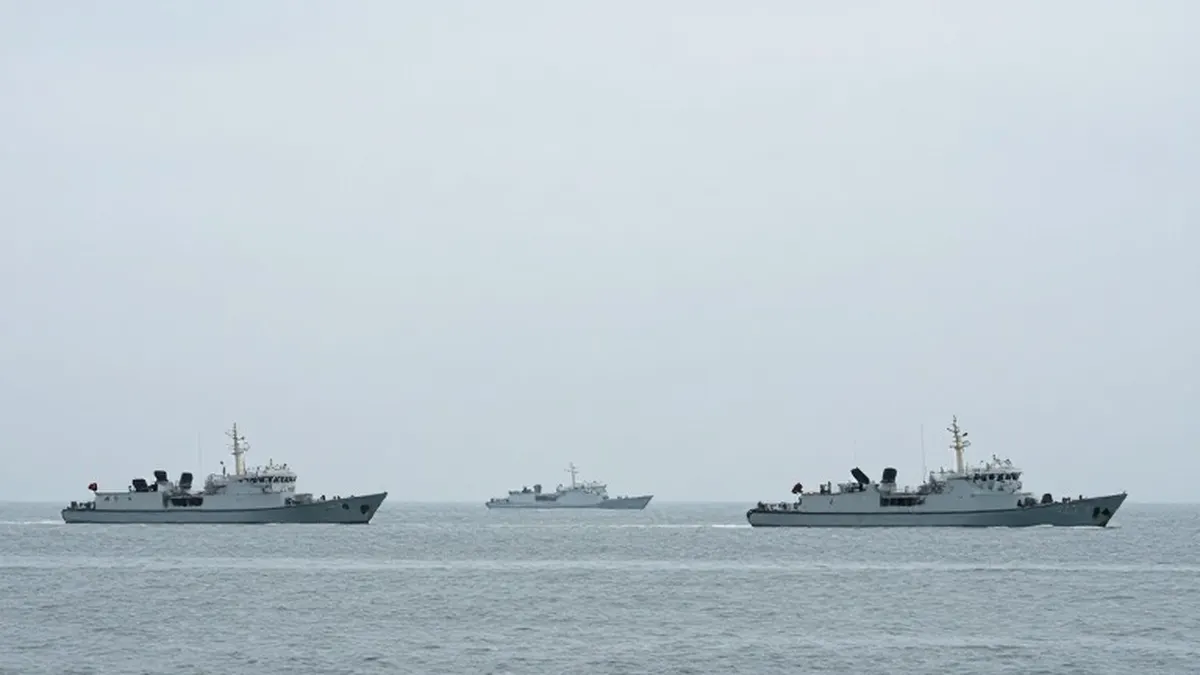
Chinese officials describe trilateral talks in Shenzhen as a landmark moment for global stability
China has confirmed that President Xi Jinping will meet with US President Donald Trump and Russian President Vladimir Putin this week in Shenzhen, with discussions expected to focus on strategic stability and world peace.
By Francesca Youssef ·
The Chinese foreign ministry has announced that an unprecedented meeting between President Xi Jinping, US President Donald Trump, and Russian President Vladimir Putin will take place in Shenzhen this week. The talks, scheduled for Thursday, will occur on the sidelines of the Asia-Pacific Economic Cooperation summit. Officials in Beijing described the agenda as covering topics of groundbreaking significance, with a primary focus on safeguarding world peace.
This trilateral gathering serves to solidify President Xi’s position as a major global powerbroker while he hosts the event in the southern technology hub. Although the specific details of the agenda remain somewhat opaque, there is significant hope among international observers, including the United Nations secretary general, that denuclearisation will be a central topic. This would mark a critical conversation among the world’s three largest nuclear powers.
In a phone conversation earlier this week, China’s top diplomat, Wang Yi, and US Secretary of State Marco Rubio discussed the importance of high-level dialogue. According to the US state department, the two officials agreed that such conversations are vital for advancing goals related to peace and denuclearisation. China was the final nation to confirm the meeting, though its official statement did not specify the exact items to be discussed.
Mao Ning, a spokesperson for the Chinese foreign ministry, stated that the leaders will engage in in-depth exchanges on promoting strategic stability in major-power relations. She noted that stronger communication among China, Russia, and the United States, along with the management of their differences, serves the interests of all three nations. This diplomatic language underscores the desire for a more stable international environment.
UN Secretary General António Guterres expressed optimism on Monday, suggesting that if the three leaders commit to meaningful denuclearisation efforts, it would be a significant achievement for the world. However, many analysts advise caution, warning that expectations for a major breakthrough should be tempered. The complexity of the issues involved makes a simple resolution unlikely.
Ryan Hass of the Brookings Institution noted that President Xi is positioned to benefit from the role of convener and agenda-setter. He suggested that the symbolic value of the meeting may prove more enduring than the substantive outcomes. Xiaoyu Pu from the University of Nevada added that the three leaders are approaching the talks with very different priorities, which could complicate the discussions.
China has previously been reluctant to join nuclear arms talks involving Russia and the US, given their larger stockpiles. President Trump has expressed a desire to discuss denuclearisation and the US-Israeli war in Iran. China, which is a major economic partner of Tehran, has sought to mediate in that conflict and considers avoiding a return to hostilities a top priority. In contrast, the Russian invasion of Ukraine may not be a primary focus, despite President Putin’s reported interest in the topic.
US officials indicated that President Trump is not expected to raise the issue of Ukraine, and German President Frank-Walter Steinmeier remarked that President Xi displayed irritation when the topic was recently mentioned in relation to the trilateral talks. Peter Alexander of Z-Ben Advisors told CNBC that the primary political benefit for President Xi lies in his ability to bring both President Putin and President Trump to the table.
Reports from the Wall Street Journal indicated that the Trump administration had pushed back against Beijing’s initial demands for a tightly scripted summit with limited room for discussion. Sari Arho Havrén from the Royal United Services Institute explained that China prefers to avoid surprises and ensure that the host does not lose the spotlight. This approach reflects a desire to control the narrative and prevent the conversation from drifting into areas where China is less prepared.
As the leaders prepare for their meeting in Shenzhen, the outcome remains uncertain. The convergence of these three powerful nations offers a unique opportunity for diplomatic progress, but the differing strategic interests of each country present significant challenges. The coming days will reveal whether the symbolism of the gathering translates into tangible agreements on global security.